How to read the label on an alcohol-free wine
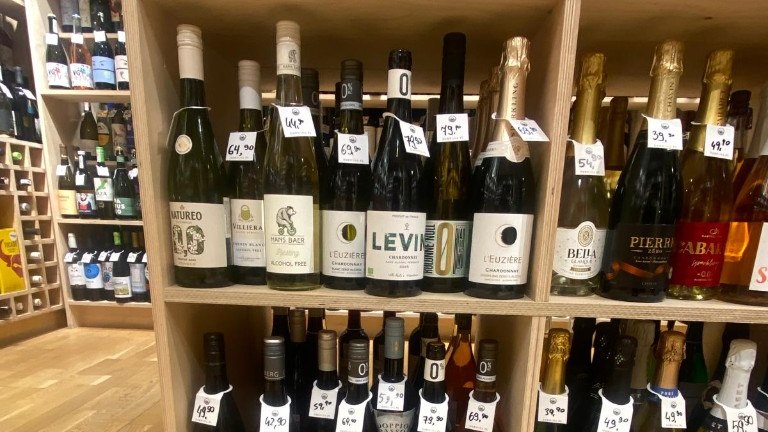
What "0.0%", "alcohol-free" and "dealcoholised" mean on the bottle: strength, ingredients, QR, sugar and calories per 100 ml, with no health advice.
Published 12 October 2026. General information on labelling; it does not replace legal or medical advice. Related: the 2026 European wine law, the Spanish dealcoholised wine market.
Natureo Muscat, from Torres, first appeared in 2008, and the winery says so itself on the back label: “en 2008 fuimos uno de los pioneros en conseguir desalcoholizados de calidad” (in 2008 we were among the pioneers of quality dealcoholised wines). For talking about labels this bottle has another virtue. Its back label carries almost everything worth looking for on any bottle of this kind, from the product name and the strength figure to the nutrition table and the bottler. What follows reads the Spanish version of the label. Figures and wording can differ from one batch to another, so what counts is what is printed on the bottle in your hand.
Today's words and 2027's
It helps to start with the calendar, because the words on these labels currently sit between two regulations. The categories desalcoholizado (dealcoholised, strength not above 0.5 % vol) and parcialmente desalcoholizado (partially dealcoholised) are set out in Article 119 of Regulation (EU) 1308/2013, in the wording of Regulation (EU) 2021/2117, which has applied since 8 December 2023. The common shelf language, that is “sin alcohol” and “0,0 %”, comes from Regulation (EU) 2026/471: it is already in force, but the new wording does not apply until 19 September 2027. The detail, with the chart of strength bands, is in the article on the 2026 law. While the transition lasts, the bottle is better read by its small figure and its category word than by its big headline word.
Until 19 September 2027 the category word the regulation sets for wine is “desalcoholizado” (dealcoholised); “sin alcohol” (alcohol-free) and “0,0 %” become regulated terms from that date.
The front label: “0,0” as a drawing
On the front label of Natureo Muscat the name sits at the top, “Desalcoholizado” is set small beneath it, and most of the field is taken by an enormous “0,0” built from leaves and white flowers, with the word “Muscat” at the foot. It reads as design: the figure is drawn and there are no units beside it. The mandatory strength line is on the back, next to the volume. The front has also changed from batch to batch. In another version “0,0 % desalcoholizado” appears on a round sticker on the shoulder of the bottle, and the vintage 2017 is printed under the name. The words on the front change; the category word, the strength figure and the product name stay on the back.
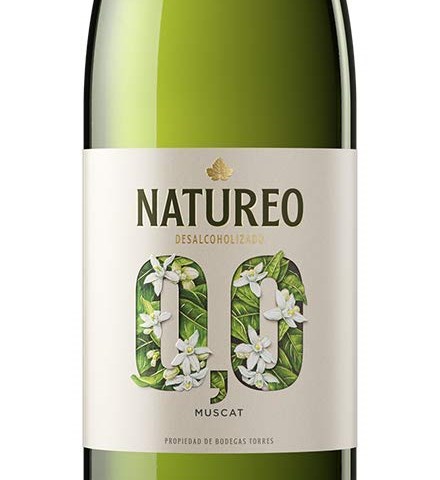
The photo is the front label of Natureo Muscat from the Amazon listing. The ovals mark “Desalcoholizado” and the drawn “0,0”. The line turns red when the pointer is over it.
The back opens with the heading “Blanco desalcoholizado” and a paragraph from the winery saying that after fermentation “se extrae únicamente el alcohol, manteniendo todo su aroma y sabor” (only the alcohol is removed, keeping all its aroma and flavour). That is the brand's story. The content begins lower down, under a thin line, in light grey small type that is easy to miss on the bottle.
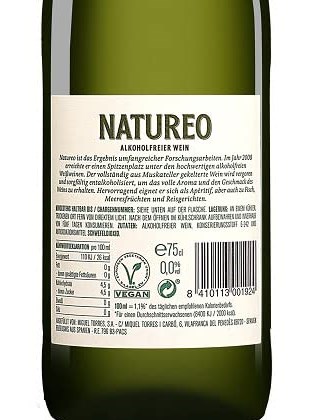
The photo is the complete back label from the same listing, in German. The oval marks the winery paragraph. The figures on this batch are not those of the Spanish label read in the text.
The mandatory strength line is on the back, next to the volume; the “0,0” on the front label is part of the design.
The product name: “bebida a base de vino desalcoholizado”
The first line under the rule names the product: “Bebida a base de vino desalcoholizado” (a drink made from dealcoholised wine). This is the sales designation, the words under which the product is sold. In Spain it is the usual way of naming wine that has had its alcohol removed: Torres has sold Natureo under this name since 2008, and other wineries use the same formula. It reads literally as a drink made from wine with the alcohol taken out. In the ingredients a little further down, the same ingredient appears as “vino desalcoholizado”, that is, as wine, which fits the designation.
The oval marks the name this German batch is sold under, “ALKOHOLFREIER WEIN”.
The key word in the line is “desalcoholizado”, and that is the one the regulation requires. Under Article 119 of Regulation (EU) 1308/2013 the name of the product category is accompanied by “desalcoholizado” if the strength does not exceed 0.5 % vol, and by “parcialmente desalcoholizado” if it is above 0.5 % but below the minimum the category has before dealcoholisation. That is why the same category word appears four times on this bottle: on the front (“Desalcoholizado”), in the back heading (“Blanco desalcoholizado”), in the designation and in the ingredients. In the criterion of the Mesa de Coordinación de la Calidad Alimentaria of 25 September 2025, Spain's Ministry of Agriculture, Fisheries and Food writes that these products are considered wine products of their own categories (wine, sparkling wine, semi-sparkling “vino de aguja” and others), so the label must carry the number of the Registro de envasadores de vinos (the register of wine bottlers).
The formula of a drink derived from dealcoholised wine is no accident in international terminology either. The International Organisation of Vine and Wine (OIV), in resolution OIV-ECO 432-2012, defines a “beverage obtained by dealcoholisation of wine” as a product made exclusively from wine, subjected only to treatments permitted for wine, including dealcoholisation, and containing less than 0.5 % vol of alcohol. It adds that the definition does not rule out the name “vin désalcoolisé” where regulation allows it. The EU relied on those definitions when, in 2021, it brought the dealcoholised wine categories into Union law.
From this comes a simple rule for the shelf. The designation is found in the small print of the back label, and within it the thing to look at is the category word, “desalcoholizado” or “parcialmente desalcoholizado”. The big words on the front (“Zero”, “0,0”, “sin alcohol”) say less about category.
From 19 September 2027 the category words change. Under Article 119 in the wording of Regulation (EU) 2026/471, the category name will be accompanied by “sin alcohol” (up to and including 0.5 % vol, with “0,0 %” as well when the strength does not exceed 0.05 %) or “reducido en alcohol” (reduced alcohol), together with the words “producido por desalcoholización” (produced by dealcoholisation). Products labelled under the earlier rules before 19 September 2027 may be sold until stocks run out. So over the coming months “desalcoholizado” and “sin alcohol” will stand side by side on the shelf.
Under the designation on the back, the word that counts is the category word (“desalcoholizado” or “parcialmente desalcoholizado”; from September 2027, “sin alcohol” or “reducido en alcohol”).
“0,0 % vol”: what that figure is
Next to the volume, to the left of the recycling symbol and the barcode, “75 cl” and “0,0 % vol” are printed. This is the strength line, that is, the ethanol left in the finished product. In the noalc catalogue Natureo Muscat is listed with a strength of up to 0.05 %, so the “0,0” is written with one decimal place.
The oval marks “75 cl” and “0,0 % vol”.
The mandatory word today for a product like this is “desalcoholizado”, and it says only that the strength is not above 0.5 %: how far below is shown only by the figure before “% vol”. The “0,0” on the bottle is for now a design device and extra information, and until September 2027 it has no definition of its own for wine. From 19 September 2027 “0,0 %” becomes a regulated term: it will be allowed only next to “sin alcohol” and only at a strength not above 0.05 %. The “sin alcohol” wording itself will mean a strength of up to 0.5 %.
Today “desalcoholizado” means a strength of up to 0.5 % vol and the figure before “% vol” gives the precise value; “0,0 %” becomes a regulated term on 19 September 2027.
Ingredients: wine, a preservative and sulphur dioxide
The ingredients list on this bottle is short: “Vino desalcoholizado de la variedad muscat, conservador E-242 y dióxido de azufre” (dealcoholised wine of the muscat variety, preservative E-242 and sulphur dioxide). Wine comes first, and neither water nor juice appears in the list, nor any added sugar. An ingredients list and a nutrition table have been mandatory on wine labels since 8 December 2023.
The oval marks the ingredients line.
Additives are named by functional class and by name or E number, hence “conservador E-242”. E-242 is dimethyl dicarbonate, DMDC (glossary), an additive authorised for wine. It helps a low-strength wine stay stable in the bottle and has nothing to do with how the alcohol is removed. The word “sulfitos” does not appear on the label, but “dióxido de azufre” is in bold: under Article 21 of Regulation (EU) 1169/2011 allergens are highlighted in the ingredients list by typeface, and for sulphites in wine the words “sulfitos” or “dióxido de azufre” are both valid. On any other bottle it is just as useful to find what it is preserved with and what has been highlighted.
The short list on Natureo Muscat names dealcoholised wine, the preservative E-242 (DMDC) and sulphur dioxide highlighted in bold.
Energy and sugar: always count per 100 ml
The nutrition table on the back gives values per 100 ml: 85 kJ and 20 kcal; fat 0 g; carbohydrate 3.6 g, of which sugars 3.6 g; protein 0 g; salt 0 g. Beside it is a glass pictogram and the line “100 ml = 1 % de calorías diarias recomendadas” (100 ml = 1 % of recommended daily calories), with a note on the adult reference intake of 8400 kJ and 2000 kcal. Regulation (EU) 1169/2011 provides for values per 100 ml, energy in kJ and kcal and this order of rows.
The oval marks the nutrition table, with the energy and the sugars.
All the carbohydrate is sugar and the ingredients list has no separate sugar, so this is the residual sugar of the wine itself. Worked out for the whole 75 cl bottle, that comes to 27 g of sugars. To compare two bottles, though, only one common basis will do, the 100 ml: a “per glass” figure is reliable only when the label states the size of the glass. On sparkling wines words such as “brut” or others about sugar sometimes appear, and they do not replace the nutrition table.
In ordinary wine the ethanol itself also supplies energy: by the coefficients of Regulation (EU) 1169/2011, 7 kcal per gram. When it is removed part of the calories go with it and the sugar stays, so these figures are best read off the label and not assumed. The body of a wine without ethanol rests partly on glycerol.
The Natureo Muscat table gives 20 kcal and 3.6 g of sugars per 100 ml, and that 100 ml basis is what allows a comparison with another bottle.
QR code and date: what can move off the label
There is no QR code on the back, and everything mandatory is printed on the bottle itself. Since 8 December 2023, Article 119 of Regulation (EU) 1308/2013 has allowed the full ingredients list and the nutrition table to move to an electronic label: the pack must show a link (a QR code or similar) with a clear indication, and behind the link there may be no advertising and no collection of user data. According to Commission Notice C/2023/1190, even if the whole nutrition declaration moves to the QR code the energy value stays on the pack, and if the electronic part is the ingredients list the allergens stay on the pack. On another bottle, then, some of the information will sit behind a QR code and some will still be on the glass.
Dealcoholised wine below 10 % vol has one more mandatory line: the date, “consumir preferentemente antes del…” (best before). Ordinary wine does not carry it.
At the bottom of the label is the bottler: “Embotellador / Bottled by: Miguel Torres, S.A., C/ Miquel Torres i Carbó, 6, Vilafranca del Penedès 08720, España / Spain, R.E. 796 B3-PACS, Product of Spain”. Next to the address is the registration code “R.E. 796 B3-PACS”. The number of the Registro de envasadores de vinos is mandatory on a wine label under Ley 24/2003 and Real Decreto 1363/2011, and the Ministry's criterion of 25 September 2025 extends this to dealcoholised products of the wine categories.
The oval marks the bottler and the registration code.
Some of the information can sit behind a QR code, but the energy value and the allergens stay printed on the pack; on this bottle there is no QR code and everything is on the label.
The method: the bottle does not name it
The winery writes only that after fermentation “se extrae únicamente el alcohol” (only the alcohol is removed). There is no vacuum distillation, no membranes and no other technique on the label, and that is usual: the fact that the product has been dealcoholised is conveyed by the word “desalcoholizado”, and the name of the technology is not among the mandatory elements. From 19 September 2027 the mandatory “producido por desalcoholización” will be added to the category word, but it will still report the fact of the treatment and the technique will remain unnamed.
On the Natureo Muscat page in the noalc catalogue the spinning cone is listed, vacuum distillation at low temperature; nothing of that is on the bottle. How that plant works is explained on the spinning cone page and in the glossary, and the general map of methods is in the technologies hub and the entry on dealcoholisation.
The Natureo Muscat label does not name the technique: the word “desalcoholizado” reports the treatment, and the method is given on the catalogue page.
Bottles that only look like wine
On the same supermarket shelves there are bottles that look like wine and also promise “sin alcohol”, although they contain no wine. They are read the same way, by the designation in the small print.
Castillo de Salobreña “tinto sin alcohol light” is sold in a wine bottle with a wine-style label: on the front “Alcohol free, sin alcohol, sans alcool” and “Especial de mesa”. On the back the designation is “Bebida refrescante aromatizada. Con azúcares y edulcorantes” (flavoured soft drink, with sugars and sweeteners). “Bebida refrescante aromatizada” is a designation from Real Decreto 650/2011 on soft drinks, foreign to the vocabulary of wine. The ingredients include water, sugars, acidifiers, colourings, apple juice from concentrate (1.9 %), preservatives, sweeteners and apple flavouring.
On the Don Simón “tinto de verano 0,0 sin alcohol” (the lemon-flavoured variant, 1.5 l) the front carries a large “0,0 sin alcohol” and the back says “Bebida de zumo de uva, con edulcorantes” (grape juice drink, with sweeteners): carbonated water, red must from concentrate (15 %), grape sugar, citric acid, sweeteners, colouring and flavouring. The label gives no strength figure, only “0,0”.
The difference from Natureo shows in the same designation line. On Natureo “vino desalcoholizado” is the base of the drink, and on these two bottles the word “vino” appears neither in the designation nor in the ingredients. That is why on the shelf it is worth looking in the small print for “desalcoholizado”, “bebida refrescante” or “bebida de zumo”, and not stopping at the big “sin alcohol” or “0,0”.
To know whether a bottle contains wine, the designation on the back says so before the “sin alcohol” on the front.
Pregnancy: what the official sources say
Only quotations and links here. In the questions and answers of the campaign “Embarazadas: cero alcohol”, the Spanish Ministry of Health writes: “No existe un límite de consumo que sea seguro, por lo que el único consumo seguro de alcohol durante el embarazo es el consumo cero” (there is no safe consumption limit, so the only safe alcohol consumption during pregnancy is zero consumption). On its page on preventing alcohol consumption in pregnancy, Sanidad puts it this way: “las mujeres embarazadas y las que desean quedarse embarazadas no deben consumir alcohol durante toda la gestación y desde que se planifica el embarazo” (pregnant women and those who wish to become pregnant should not consume alcohol throughout gestation and from the moment pregnancy is planned).
How these sentences relate to a bottle of one strength or another is not discussed here. The full texts: the campaign questions and answers and the Sanidad page on prevention. Questions about an individual case belong with a doctor.
A short shelf checklist
- The figure before “% vol”, next to the volume. The word “Zero” or “0,0” on the front does not replace it.
- The designation in the small print: the category word (“desalcoholizado”, “parcialmente desalcoholizado”, and from September 2027 “sin alcohol” or “reducido en alcohol”) or phrases such as “bebida refrescante” and “bebida de zumo”.
- The nutrition table per 100 ml: energy in kJ and kcal, carbohydrate and sugars.
- The ingredients: whether there is wine, which E numbers appear, whether “dióxido de azufre” or “sulfitos” is highlighted.
- The bottler and the registration code next to the address.
- The QR code: where it leads and what has stayed printed.
- The method: if named, check it against the technologies hub; if not, it stays unnamed.
The law is explained in more detail in the article on 2026, and the market and the shelf in Spain are described in the article on the alcohol-free wine market.
Sources
- Regulation (EU) 1308/2013, Art. 119 and Annexes VII and VIII (consolidated version)
- Regulation (EU) 2021/2117
- Regulation (EU) 2026/471 (Spanish text, OJ 26.2.2026, Art. 1 point 10, Arts. 5 and 6)
- Corrigendum to Regulation (EU) 2026/471 (OJ L 2026/90408, 22.5.2026)
- Regulation (EU) 1169/2011, food information to consumers (Arts. 21 and 32, Annexes X, XIII, XIV)
- Delegated Regulation (EU) 2019/33 (Arts. 40, 41 and 48a)
- Delegated Regulation (EU) 2019/934 (Annex I, Part A, Table 2, DMDC)
- Commission Notice C/2023/1190 (electronic labelling, questions and answers)
- OIV, resolution OIV-ECO 432-2012, beverage obtained by dealcoholisation of wine (French)
- OIV, “The new CAP makes dealcoholised wines official” (7.12.2021; Spanish page)
- MAPA, criterion of the Mesa de Coordinación de la Calidad Alimentaria (25.09.2025), dealcoholised vine and wine products and the Registro de envasadores (Spanish)
- Ley 24/2003 on Vine and Wine, fourth additional provision (Spanish)
- Real Decreto 1363/2011, labelling of wine products, Art. 4 (Spanish)
- Real Decreto 650/2011, soft drinks (Spanish)
- Sanidad, frequently asked questions “Embarazadas: cero alcohol” (Spanish)
- Sanidad, prevention of alcohol consumption in pregnancy (Spanish)
- El Aderezo, “Bodegas Torres saca al mercado Natureo, un vino casi sin alcohol” (26.04.2008; Spanish)