Dealcoholised wine from the vineyard: GO UBAVIDA and how eight other countries tackle alcohol-free wine
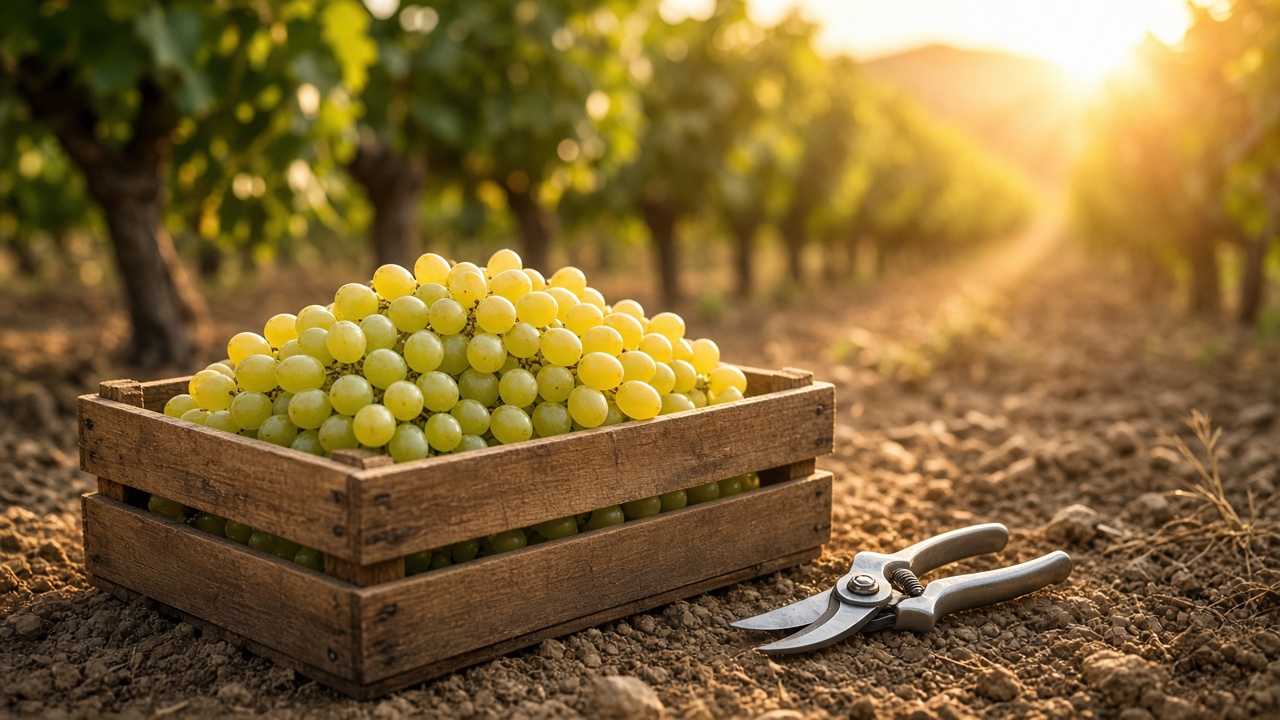
Alcohol-free and low-alcohol wine is no longer only a cellar problem: GO UBAVIDA designs lower-sugar grapes at harvest. First 2024–2025 results and a map of eight countries with no global consensus.
Updated in September 2026 with the first harvest results, microvinifications and the consortium’s demonstration workshop. Related: aromatic whites, Spain market, alcohol-free red.
A change of lens
The standard approach to dealcoholised wine is almost offensively simple: make a conventional wine, then take the alcohol out. Vacuum distillation, reverse osmosis, spinning-cone column: the menu is familiar. Spain’s GO UBAVIDA project asks the question the other way round. What if the quality of dealcoholised wine (and of low-alcohol wine) is decided not by how the alcohol is removed, but by what the grape was like before it became wine?
That shift, from cellar to vineyard, is what makes the initiative interesting. Not just as a local R&D effort, but as one of several competing hypotheses about where the whole no/low category is heading: alcohol-free wine, partially dealcoholised styles and more mindful drinking occasions.
A climate reason, not only a trend
Talk of “mindful drinking” and Dry January often buries a duller, more structural reason. GO UBAVIDA itself puts it on the record: average alcohol in DOCa Rioja wines sat at 12.7% ABV until 2000; since then it has settled around 13.4% and is still climbing. More than half a degree in a quarter-century. Grapes are ripening earlier in a warmer climate: sugar in the berry races ahead of aroma and phenolics.
More than half a degree in a quarter-century; sugar arrives before aroma.
Source: GO UBAVIDA.
For dealcoholisation, the problem starts at the intake. The higher the starting alcohol, the more volume you lose taking it out, and the harder the aroma is hit. That is why a harvest designed for alcohol-free wine matters as much as the removal kit.
Who, how much, and what for
The project’s official name is Sustainable strategies from vineyard to cellar to obtain low-sugar grapes and dealcoholised wine (UBAVIDA). It is a supra-regional operational group under Spain’s CAP Strategic Plan 2023–2027, launched by a FEGA resolution of 5 August 2024. Total budget: €607,342.27. The grant is €599,741.95: 80% from the European Agricultural Fund for Rural Development (EAFRD) and 20% from Spain’s Ministry of Agriculture (MAPA). Four years of work, starting in November 2024.
Grant €599,742: 80% EAFRD, 20% MAPA. Four years from November 2024.
Source: FEGA / GO UBAVIDA.
Roles in the consortium are split: FEUGA coordinates communications; Bodega Matarromera leads the technical side. Also involved: Bodega Win Sin Alcohol, the VITEC technology centre, the CIAL-CSIC-UAM institute (through its applied oenological biotechnology group), Bodegas Enguera (via its own R&D programme, Enguera Planet) and Paco & Lola. Subcontracted: the Spanish Wine Technological Platform (PTV) and the Spanish Wine Federation (FEV, more than 950 wineries). The project spans five autonomous communities: Castile and León, Catalonia, Valencia, Galicia and Madrid.
Method: three phases and one still-unmapped territory
Phase 1 is agronomy: finding the harvest window that yields lower-sugar grapes without giving up aromatic and phenolic potential. Varieties: Verdejo and Tempranillo. Two observation seasons, 2024 and 2025. The main technique under test is kaolin on the leaf: a mineral suspension that reflects sunlight, eases heat and water stress, and slows sugar build-up without dehydrating the berry. Bodegas Enguera’s technical lead puts it this way: kaolin reflects solar radiation, improves the vine’s physiological state, and as a side effect helps against pests and disease. The second technique on trial is green harvesting.
Phase 2: tuning vinification to grapes whose sugar profile has already changed.
Phase 3 is what the project itself calls previously unstudied ground: comparing the aromatic, polyphenolic and bioactive profile of dealcoholised wines with their donor wines, including how those bioactive compounds behave (and what they do to health) once alcohol is gone. There is, for now, simply no prior literature.
The last block is consumer testing by segment, plus a report on technical and legal barriers meant to land on regulators’ desks.
First results: harvest, microvinifications and outreach
After two harvest seasons (2024 and 2025), Bodega Matarromera and Bodega Win Sin Alcohol say they have hit GO UBAVIDA’s first milestones and that the model holds: designing the grape for alcohol-free and low-alcohol wine in the vineyard, not only dealcoholising afterwards.
In the field they identified the best picking window for Verdejo and Tempranillo: less sugar in the berry, without giving up aromatic and phenolic potential. That work moved into the cellar through more than 30 microvinifications, testing how this fruit responds to different winemaking routes and how to compensate for the imbalance typical of grapes grown for dealcoholised or partially dealcoholised wine.
In November 2025, Win Sin Alcohol and Matarromera tasted the 2025-harvest wines: lower starting alcohol and clear progress on choosing the right ripening point. In May 2026 the consortium held a demonstration workshop at Paco & Lola (Pontevedra) on kaolin, green harvesting, dealcoholisation and aroma reconstruction: moving R&D trials into sector outreach.
Which Spanish whites hold up in the glass after that operation (Verdejo already in volume, Albariño with an international score, Godello still without a 0.0% bottle) is the subject of Verdejo, Albariño and Godello. Alcohol-free red, for its part, remains the hardest bottle on the shelf: why.
Their reading is clear: combining innovation in viticulture, winemaking and dealcoholisation can improve the quality of alcohol-free and low-alcohol wine more than betting on removal technology alone.
The quiet legal paradox
One regulatory wrinkle is almost never said out loud. EU common agricultural policy has formally put dealcoholised wine in the legal category of “wine”. But the oenological practices tied to dealcoholisation itself are not on the list of practices allowed in organic production. So a dealcoholised wine cannot be organic, even if the starting wine was, simply because removing alcohol is not on the approved list.
It is a narrow, real contradiction. Worth watching whether lifting that barrier makes it into GO UBAVIDA’s final report to regulators.
Not a one-off grant: a strategy
GO UBAVIDA is not Win Sin Alcohol / Matarromera’s first R&D run in this field. They previously completed Alcoholess, funded by Spain’s State Research Agency, the Ministry of Science and Innovation and the European Regional Development Fund (ERDF), a project focused purely on technology: cutting aroma losses during dealcoholisation and identifying the molecules involved. GO UBAVIDA is the next floor up: not the cellar this time, the vineyard. The company claims more than twenty years of R&D leadership in dealcoholisation. If that holds, it is a structural edge over competitors only now walking into the category.
A world map: eight countries, at least five strategies
This is the analytical part, and what lifts GO UBAVIDA out of a routine operational-group story. The same problem, climate-driven alcohol creep, is being tackled in at least eight wine countries, and tackled in fundamentally different ways.
Italy. A peer-reviewed paper from June 2026 (the journal Horticulturae) is blunt: designing vineyard systems specifically for modern low-alcohol wines remains an unsolved task. Italian researchers are testing a different lever from Spanish kaolin: aggressive shoot and canopy pruning to cut sugar concentration hard. Another 2025 peer-reviewed paper goes further: low-sugar viticulture should be treated as a strategy in its own right, not a helper technique before dealcoholisation, and that fruit should not be read as lower-quality product.
United States. The focus is structurally different. The flagship industry event (UC Davis’s April 2025 seminar) was built around dealcoholisation technologies and go-to-market strategy, not vineyard agronomy. A 2025 peer-reviewed review states outright that scientific literature on using low-sugar grapes as raw material for this category is scarce. The gap GO UBAVIDA is walking into had not, at the time of that review, been closed anywhere.
Australia. The most ambitious position, and the widest. The Australian Wine Research Institute (AWRI) states a national aim: Australia can become the world’s leading producer of “lifestyle wines”, wines with less alcohol and fewer calories than the traditional ones. The institute is running work on several fronts at once: microbial stability and shelf life, aroma capture and reuse, the missing texture and mid-palate, consumer acceptance. Australia also has a regulatory card Spain does not: Food Standards Australia New Zealand allows water to be added to must to moderate finished alcohol. That legal path is not open in Spanish or EU law, which makes agronomic pre-adaptation, kaolin included, relatively more important in Spain.
New Zealand. The picture is incomplete, and that should be said plainly. Around 2015 the Bragato Research Institute ran a Lifestyle Wines Programme, and New Zealand billed itself as the world’s largest market by share of reduced-alcohol wine: in supermarkets (about 65% of all wine sold in the country) that share rose from 0.2% to 2.3% in three years. Confirmation that the programme is still a priority is harder to find. BRI’s 2026 contestable funding round (about NZ$300,000, announced in March) lists circularity, vineyard efficiency, fewer chemical inputs, genetic resilience and soil/water health. Low-alcohol wine is not named. That is a data gap, not a settled fact: the work may simply be poorly covered in public, not shut down.
Argentina. The only Latin American country with a working state institute on the subject: INTA runs a pilot plant at the experimental station in Luján de Cuyo, Mendoza. An institute specialist is direct: the process is legal, but expensive. Wine must go through a full alcoholic fermentation first; only then is the alcohol removed, and the kit is costly and still not imported at the volume needed. In parallel, a different bet, one that does not overlap with Spain’s, is local criolla varieties (Pedro Ximénez, Torrontés, Muscat, Criolla Chica and Criolla Grande), whose natural profile suits lower-alcohol wines, plus earlier picking and gentle maceration. There is no single funded consortium at GO UBAVIDA scale. Effort is split among individual wineries (Catena Institute, Nieto Senetiner, La Riojana) and INTA’s modest pilot.
Chile. No major national programme turned up. Chilean climate adaptation in the vineyard is concentrated on rootstocks, training systems and irrigation in general, not on low-alcohol wine as such. The one concrete find is a 2024 applied student project at Duoc UC: the team used fruit from green thinning (berries usually discarded to raise quality in the remaining cluster) as the base for a ferment that is then blended into conventional wine to drop alcohol without losing sensory character. Conceptually neat: turning a production waste stream into a tool. In scale it is a classroom project, not national R&D, and it should not be oversold.
South Africa. No specialised agronomic programme for this task either. The relevant state institute, ARC Infruitec-Nietvoorbij (Stellenbosch), has a broad mandate (breeding, growing and postharvest for vine and pome/stone fruit) and no publications specifically on low-sugar grapes. What South Africa does have is a clearly stated strategy of another kind: a Darling Cellars representative argues that local dealcoholised wines should be compared not with conventional wine but with the best in the category worldwide. The domestic market is still small and hard to convert; abroad, especially in the United States, South African dealcoholised wines are already known and sit in a premium price band. That is export positioning of a finished product, not vineyard science.
What the comparison shows
The eight-country map is not a binary of “Spain versus the field”. It is at least five structurally different answers to the same climate problem:
- agronomy via heat and sun-stress management (Spain: kaolin);
- agronomy via aggressive canopy pruning (Italy);
- agronomy via native genotype (Argentina: criolla varieties);
- post-fermentation dealcoholisation technology and business strategy, with little vineyard emphasis (United States);
- a broad national tech-and-marketing strategy, backed by more permissive rules (Australia);
- export positioning of the finished product, without viticultural R&D (South Africa).
It is striking that two countries with deep wine traditions, the United States and South Africa, are not taking the vineyard-agronomy path at all. That recasts GO UBAVIDA: the Spanish project is not chasing a global consensus, because no such consensus exists. It is a distinct strategic bet. And it has a concrete edge over the German and French approach, strong on post-fermentation technology and weaker on the viticulture underneath it. If GO UBAVIDA’s final report on technical and legal barriers does reach regulators, as the project says it will, Spain has a real chance to be first with officially permitted oenological practices for low-sugar viticulture: not catching up to someone else’s rules, but writing them.
Two questions are worth keeping in view over the medium term. First: whether the techniques now on the table (kaolin, canopy pruning, native genotype, watering the must) become a race to see who first lands stable, aromatic raw material. That fight looks like it will be decided in the vineyard, not in the marketing of a finished bottle. Second: whether GO UBAVIDA’s final recommendations include revisiting organic status for dealcoholised wine. That remains a blind spot for the whole category, and none of the eight countries has put this specific problem on the public record.
Sources
- FEUGA / ubavida.es: official UBAVIDA (GO UBAVIDA) materials, including the 2025-harvest wine tasting
- Bodega Matarromera / Win Sin Alcohol: press materials and statements on the 2024–2025 seasons
- Bodegas Enguera (Enguera Planet): statements from the project’s technical lead
- AKIS / Paco & Lola: May 2026 demonstration workshop (Pontevedra)
- European Commission CAP Network: publications on EIP-AGRI operational groups
- Retail Actual (Spain): trade coverage of the project
- Horticulturae (MDPI): peer-reviewed 2025–2026 papers on viticulture for low-alcohol wine
- University of California, Davis: seminar “Bringing Low and No-Alcohol Wines to Market” (April 2025)
- Australian Wine Research Institute (AWRI): strategy publications
- Food Standards Australia New Zealand: regulatory materials
- Bragato Research Institute (New Zealand): Lifestyle Wines Programme and 2026 funding round
- INTA (Argentina) / Infocampo
- Observatorio Duoc UC (Chile)
- Darling Cellars (South Africa)
- noalc: Verdejo, Albariño and Godello